Multipliers sit in an odd spot on Deriv. They trade like a derivative but borrow their logic from leveraged positions, which trips people up if they’re coming in with a background in either options or straight leveraged forex. The core idea: you put down a stake, pick a multiplier, and your gains or losses scale by that factor relative to the market’s move. But unlike straight leverage trading, your downside is capped at your stake. No margin calls, no owing more than you put in. Here’s how the mechanics actually work and where multipliers fit against Deriv’s other trade types. Multipliers increase your exposure to an underlying market, which means both potential profits and potential losses can be amplified. Investopedia’s guide to leverage provides useful background on how increased market exposure can magnify investment outcomes.
Before you can proceed further with this you can create your Deriv account here.
How Multipliers Work
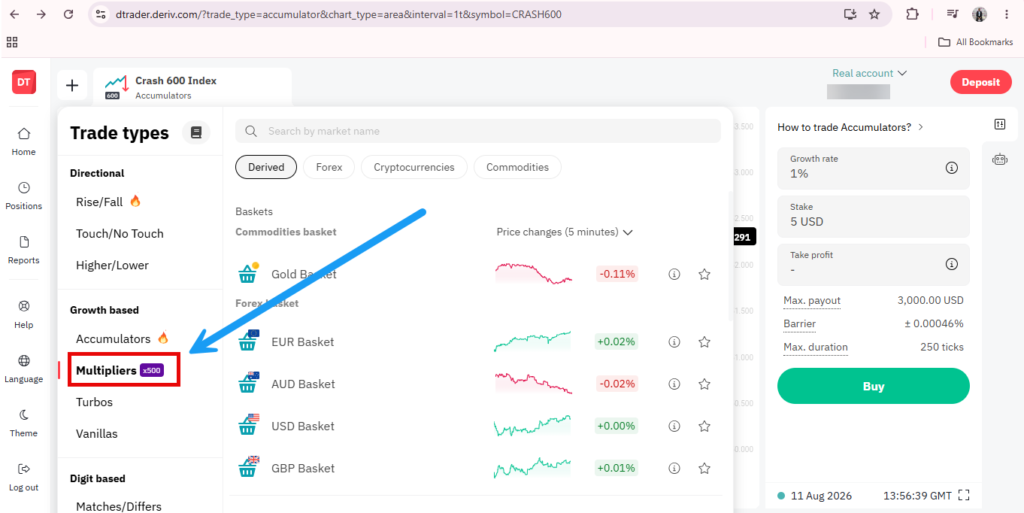
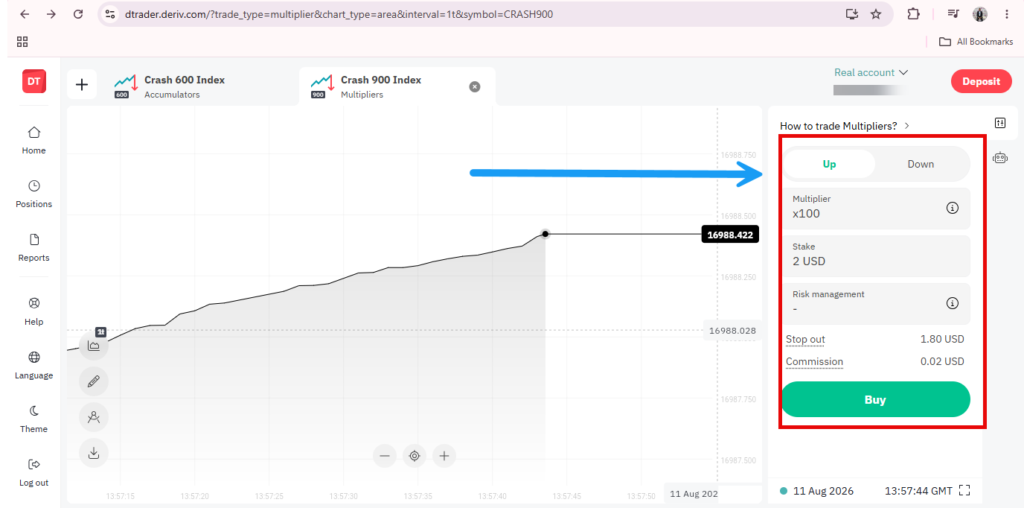
With a Multiplier, you choose a stake and a multiplier value. Your potential profit or loss scales with both the market’s price movement and the multiplier you’ve selected, rather than being tied to a fixed payout like some other trade types.
What Makes Multipliers Different
- No fixed expiry — the position stays open until you close it or it’s stopped out
- Loss capped at your stake — you can’t lose more than what you put in
- Amplified exposure — price movements have a larger effect on your position than the underlying market move itself
- Optional deal cancellation — a feature some accounts can add for extra protection within a set window
The Upside of How Multipliers Are Structured
Because loss is capped at your stake, you know your maximum possible downside before you start. The lack of a fixed expiry also means you’re not forced out of a position at a set time, giving more flexibility over when to close it.

The Trade-Off Worth Understanding
Amplified exposure cuts both ways — the same multiplier that increases potential gains also increases potential losses relative to the underlying price movement, up to your capped stake. Because there’s no fixed expiry, it’s also on you to decide when to close a position, rather than the platform doing it automatically.

Where Multipliers Sit Among Deriv’s Trade Types
Compared to Options, which have a fixed payout and expiry, Multipliers are more open-ended and directly tied to ongoing price movement. Compared to Accumulators, which grow steadily within a range, Multipliers respond immediately to price direction rather than compounding over time. Our guide on What Are Trade Types on Deriv? covers how all of these compare side by side.
Trading products are one way to use Deriv, but plenty of people never trade at all and still earn from the platform, simply by referring others to it. Here’s the other side of Deriv worth understanding, even if just out of curiosity.

FAQ: Multipliers on Deriv
Can I lose more than my stake with a Multiplier? No, loss is capped at your stake, regardless of how the multiplier amplifies the price movement.
Do Multipliers have an expiry time? No, positions stay open until you close them or they’re stopped out, unlike some other trade types with a fixed expiry.
What is deal cancellation on a Multiplier? It’s an optional feature on some accounts that allows cancelling a trade within a set window, subject to specific terms.
Are Multipliers available on all Deriv platforms? Availability can vary by platform and account region, so check within Trader’s Hub for what’s accessible to you.