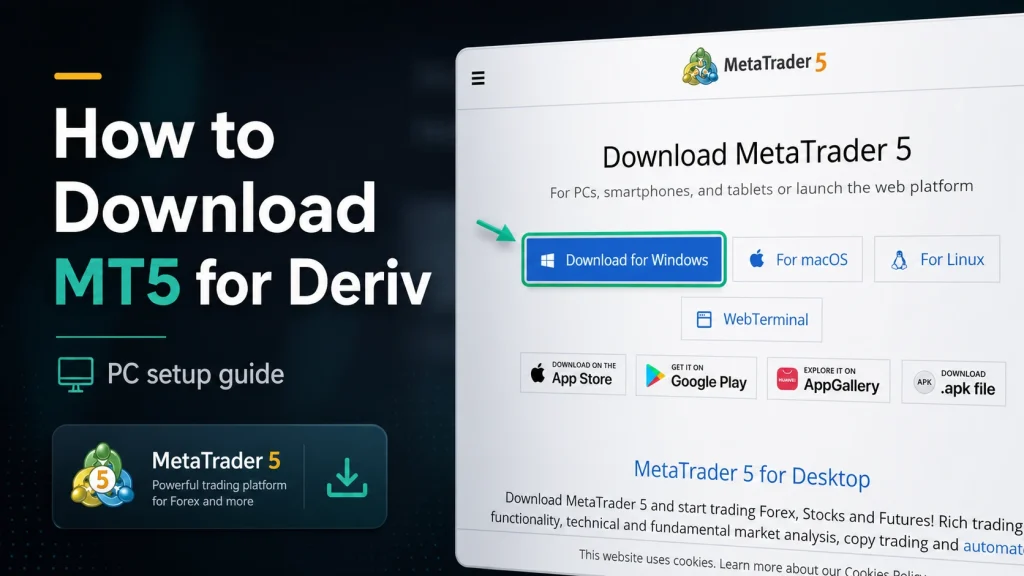
Deriv doesn’t just offer one way to trade. It bundles together forex, synthetic indices, stocks, commodities, and multipliers under a single account structure, and each of those comes with its own rules, risk profile, and platform. New traders often assume “trading on Deriv” means one thing, then get confused when a strategy that works for forex doesn’t translate to synthetics. It helps to think of trade types less as variations on the same theme and more as genuinely different markets that happen to share a login.
Here’s a breakdown of what’s actually on offer and how each one behaves. Many of the trade types available on Deriv are based on the movement of an underlying market rather than direct ownership of the asset itself. Investopedia’s guide to derivatives provides useful background on how financial contracts can derive their value from underlying assets or market movements.
As a starting point you will need to create a Deriv account here.

Options: Rise/Fall, Higher/Lower, and More
Options are prediction-based contracts, where you’re forecasting a market outcome within a set timeframe, for a fixed potential payout known upfront. This isn’t one single format. It is a category covering several distinct contract types, each based on a slightly different question:
Ends Between/Ends Outside — will the price finish inside a defined range at expiry, or outside it?
Rise/Fall — will the price be higher or lower than it is right now, at a set point in the future?
Higher/Lower — will the price finish above or below a barrier you choose yourself, separate from the current price?
Touch/No Touch — will the price touch a set barrier at any point during the contract, or avoid it entirely?

Multipliers
Multipliers let you amplify exposure to a market’s price movement using a chosen multiplier, while capping your maximum loss to your stake through an automatic stop-out. There’s no fixed expiry time built in, so the position stays open until you close it yourself or it’s stopped out, though optional protections like deal cancellation exist on some accounts for an added cost. Learn more in What are multipliers on Deriv.

Accumulators
Accumulators grow in value tick by tick, as long as the price stays within a chosen range around the previous tick. You select a growth rate, which determines both how quickly the stake grows and how tight that range is. If the price moves outside the range at any point, the contract knocks out immediately and the stake is lost. There’s also a tick limit, so the contract closes automatically once that’s reached, even if the price never leaves the range. In What are Accumulators on Deriv we get into more detail.


Vanilla Options
Vanilla Options work closer to traditional options trading, letting you choose a strike price and buy either a Call (predicting the price finishes above the strike) or a Put (predicting it finishes below). Unlike Turbos, there’s no barrier to breach mid-contract. Only the final price at expiry, compared to your strike, determines the outcome.

Turbos
Turbo Options are barrier-based contracts where you pick a direction (Up or Down) and a barrier. The payout depends on the price never breaching that barrier during the contract. Breach it at any point, and the contract ends immediately with no payout, regardless of where the price goes afterward. If the barrier holds until expiry, the payout is based on the distance between the final price and the barrier.

Why So Many Trade Types Exist
Each trade type suits a different way of engaging with market movement some are built around predicting direction, others around price staying within or breaking a range. None of them are inherently better than another; they’re simply structured differently. If you’re still finding your way around the platform generally, our guide on A Complete Tour of the new Deriv dashboard is a good starting point, and What Is the Deriv Wallet? covers the funding side once you’re ready to explore any of these.
Trading products aside, there’s a completely different way people generate income from Deriv without touching a chart at all simply by referring others to the platform. Worth a quick look if that’s new to you.
FAQ: Trade Types on Deriv
Do all trade types carry the same level of risk? Risk varies by structure — for example, Multipliers cap loss at your stake, while Options have a fixed payout tied to a specific prediction. It’s worth reading the specific terms for whichever type you’re considering.
Are all trade types available on every platform? No, availability depends on which Deriv platform you’re using, such as Deriv Trader versus MT5, and your account region.
Can I try trade types on a demo account first? Yes, demo accounts let you explore each trade type without using real funds.
Which trade type is best for beginners? This depends on personal preference and risk tolerance rather than a single right answer — trying a few on demo first is a reasonable way to get a feel for how each one behaves.