Turbo options push the risk-reward tighter than vanillas. You’re betting on price staying above or below a barrier through expiry, and that barrier sits close to the current market price, which is exactly what makes payouts sharper and durations shorter. There’s no premium calculation to puzzle over like with vanillas; you know your payout upfront, and the trade lives or dies on whether the barrier holds. Faster-moving, higher-conviction bets fit this instrument better than a slow grind, since a barrier that close leaves little room for the market to wander before knocking you out. Here’s how strike distance, expiry, and payout scale against each other in practice

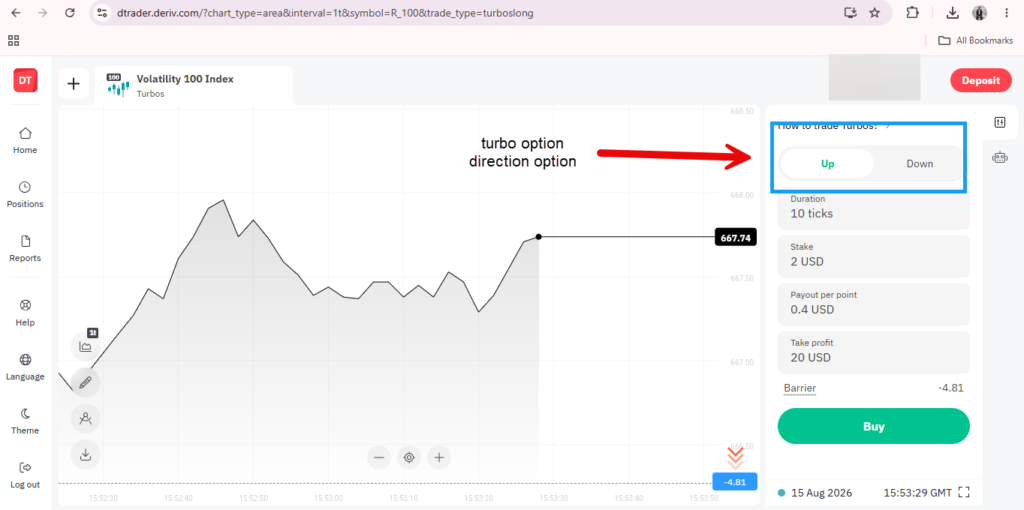
Choosing a Direction
You pick either “Up” or “Down,” predicting which way the market will move relative to a barrier you set. This single decision — direction plus barrier placement — is really the entire setup for a Turbo Options trade, which is part of what keeps it fast to place once you understand the mechanics.
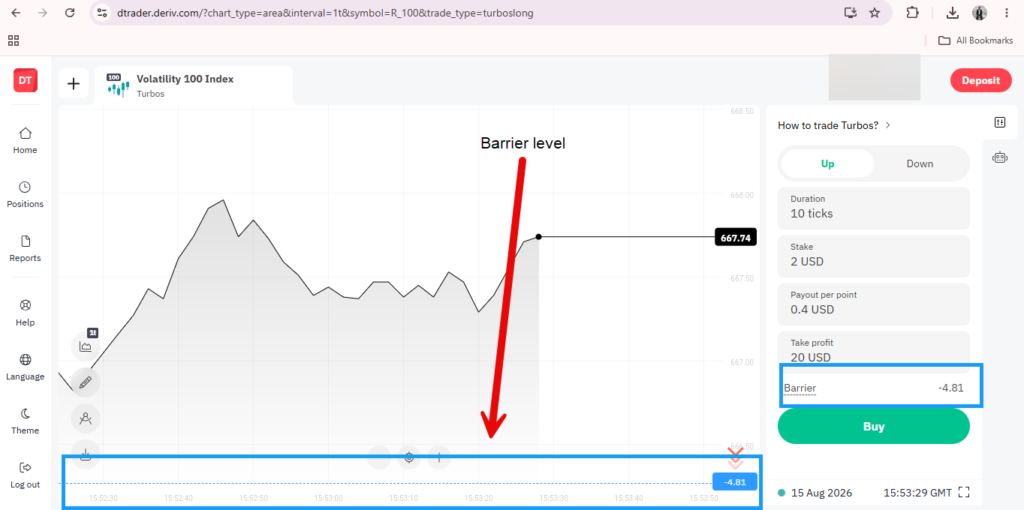
The Role of the Barrier
If you choose “Up,” you earn a payout as long as the price never drops below the barrier during the contract. If you choose “Down,” the payout depends on the price never rising above it. Breaching the barrier at any point ends the contract early with no payout — it doesn’t matter if the price recovers afterward, since the breach itself is what closes the contract.
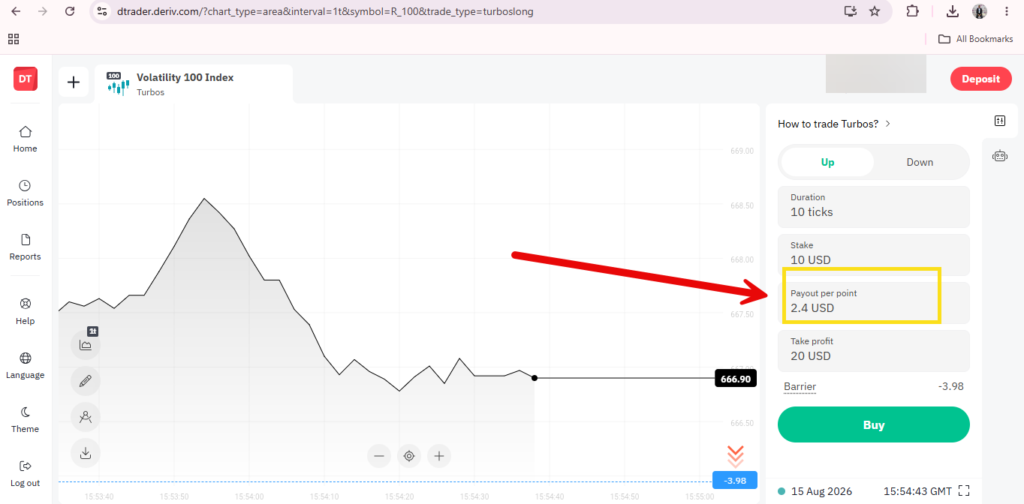
How the Payout Is Calculated
Payout is based on the payout-per-point multiplied by the distance between the final price and the barrier at expiry, assuming the barrier wasn’t breached along the way. In practice, this means the payout isn’t fixed at a single number when you open the trade — it grows the further the price moves away from the barrier in your favor, up until expiry.
Selling Before Expiry
Turbo Options can be sold early, up to a short window before expiry, letting you lock in the contract’s current value rather than waiting it out. This is useful if you’d rather secure a gain already in place instead of risking a late breach before the contract naturally settles, though the exact cutoff window before expiry can vary by market.

How Turbos Compare to Other Trade Types
Turbo Options sit closest to Vanilla Options in overall structure, since both involve a barrier or strike price and a fixed expiry. The key difference is how they treat what happens during the contract: a Turbo knocks out immediately the moment its barrier is breached, while a Vanilla Option only cares about where the price ends up at expiry, regardless of what it touched along the way. This makes Turbos path-dependent and Vanillas endpoint-based — a distinction worth understanding before choosing between the two. Our guide on What Are Vanilla Options? covers that comparison from the other side, and What Are Trade Types on Deriv? lays out how every trade type compares side by side.
Understanding how a contract like this works is useful, but it’s worth knowing Deriv also has a completely separate way to earn — one that doesn’t involve placing a single trade. That side of the platform is explained here.

FAQ: Turbo Options on Deriv
What happens if the barrier is breached before expiry? The contract ends immediately with no payout, regardless of what the price does afterward.
Can I close a Turbo Options position before expiry? Yes, selling early is available up to a short window before the contract’s expiry time.
Is there a maximum loss on a Turbo Options trade? Your loss is capped at your initial stake, since that’s the maximum amount placed on the contract.
Are Turbo Options available on all markets? Availability depends on the specific market and your account, so check within Deriv Trader for what’s supported.
