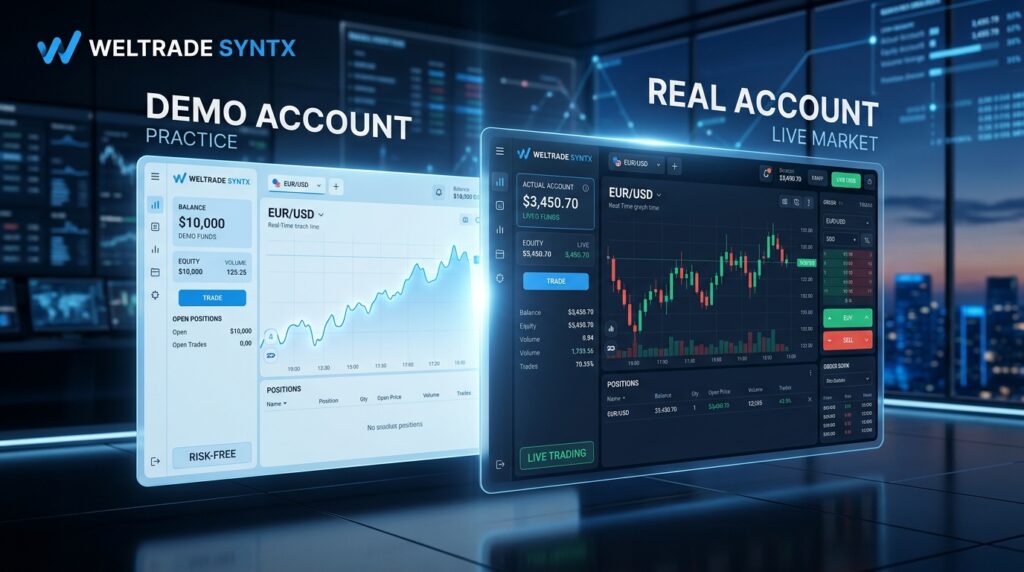
New traders exploring Weltrade often want a straight answer to a simple question: where should I actually start? The honest response requires looking past the marketing angle and comparing what beginners genuinely struggle with on each. Forex and synthetic indices have fundamentally different characteristics, so beginners may find that one fits their preferred way of learning and analysing markets better than the other. DailyForex provides a useful comparison of forex and index markets and discusses factors beginners should consider when choosing between markets.

For better context as you read this guide ensure you login into your Weltrade Account or create one here.
The Case for Starting With Forex
Forex has decades of educational material, established analysis frameworks, and a huge community generating strategies, tutorials, and discussion. For a beginner willing to put in the time, that depth of resources is a genuine advantage. You’re rarely stuck without guidance on a common forex question. Forex also trades on real economic logic, which some beginners find more intuitive to reason about than an algorithm’s internal parameters.

The Case for Starting With Synthetic Indices
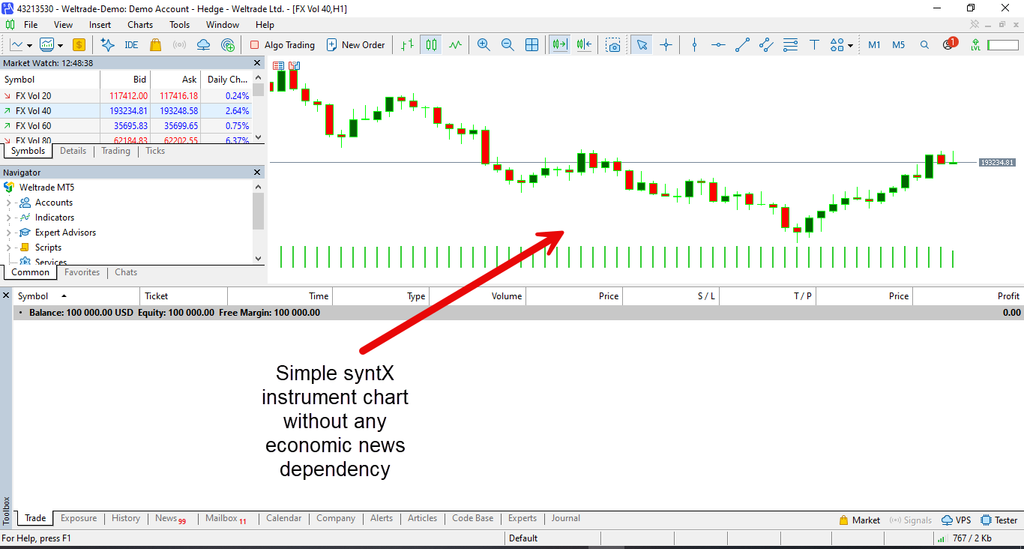
Synthetic indices remove an entire category of complexity: no economic calendar to track, no news-driven slippage, no weekend gap risk, and no need to understand geopolitical context to trade reasonably. For a beginner who finds forex’s news-dependency overwhelming, that simplification is a real advantage. The only thing to learn is how a given instrument behaves, not why the entire global economy is behaving a certain way. For more on how the two compare feature by feature, see our guide on Weltrade SyntX vs Forex: What’s the Difference?
Where Forex Is Actually Easier
Forex spreads on standard accounts, while floating, are often narrower during calm periods than SyntX’s fixed spreads, and the range of available educational content specifically for absolute beginners is more mature. Forex also offers lower typical leverage on standard accounts, which, while less exciting, gives new traders more margin for error while they’re still learning.

Where Synthetic Indices Are Actually Easier
SyntX removes the need to interpret news and its market impact, a skill that takes most forex beginners a long time to develop. It also allows practicing at any hour, including weekends, without waiting for markets to open which is useful for beginners trying to build consistent screen time around a busy schedule. And for a more direct look at whether synthetic indices specifically suit beginners, see Are Synthetic Indices Suitable for Beginner Traders.

The Leverage Caveat
It’s worth being direct here: SyntX’s significantly higher leverage cuts against its beginner-friendly reputation in one important way. While the instruments themselves are simpler to reason about, the leverage available makes it easier to lose money quickly if position sizing isn’t disciplined arguably a bigger risk for an inexperienced trader than forex’s typically lower leverage ceiling.
A Reasonable Way to Decide
Rather than picking based on which sounds more beginner-friendly in marketing copy, trying both on demo accounts for a few weeks gives a far more honest answer specific to your own learning style. Some beginners find synthetic indices’ simplicity genuinely easier to build confidence with; others prefer forex’s grounding in real-world logic, even with its steeper initial learning curve. There’s also nothing stopping a beginner from learning both in parallel, using the lessons from one like risk management, chart reading, emotional discipline, to reinforce the other, since those core skills transfer regardless of which market they were first learned on.

Making Your Own Call
Neither is definitively “better” for beginners. They trade different kinds of complexity for different kinds of simplicity. Ready to try both and see which fits you? Open a Weltrade demo account and test forex and SyntX side by side.